
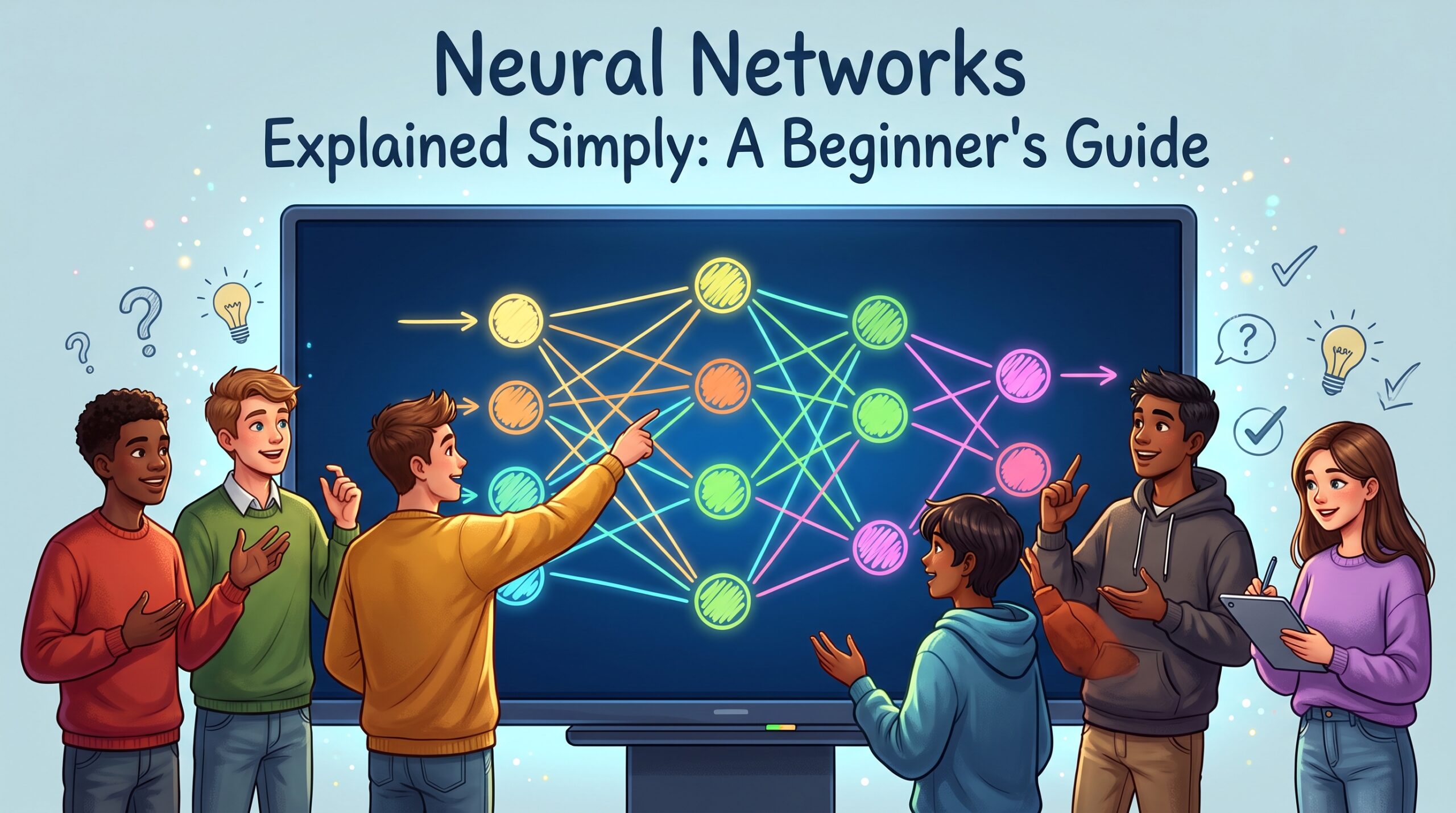
If you have ever wondered how your phone recognizes your face, how a streaming service guesses what you want to watch, or how a chatbot writes a sentence, the answer is almost always the same: a neural network. The name sounds intimidating, but the core idea is surprisingly approachable. This guide walks through neural networks explained simply, without equations, so you can build a solid mental model before you touch any code.
What Is a Neural Network?
A neural network is a computer program that learns patterns from examples instead of following hand-written rules. Rather than telling a computer “a cat has pointy ears, whiskers, and fur,” you show it thousands of labeled cat photos and let it work out for itself what makes a cat a cat.
The design is loosely inspired by the brain, which is why the parts are called neurons and the whole thing is called a network. The inspiration is loose, though. Artificial neural networks are mathematical systems, not tiny brains, and we will explore that difference in our guide to [AI vs the human brain].
The Building Blocks: Artificial Neurons
An artificial neuron is a very small calculator. It does three things:
- Receives inputs. These are numbers, such as the brightness of a pixel or the length of a word.
- Weighs them. Each input is multiplied by a weight, which says how important that input is. A large weight means “pay attention to this,” and a tiny weight means “mostly ignore this.”
- Decides what to pass on. The neuron adds everything up, adds a small adjustment called a bias, and feeds the result through an activation function that decides how strongly the neuron “fires.”
Think of it like deciding whether to go to a party. You weigh factors such as who is going, how far it is, and how tired you are. Some factors matter more than others, and together they tip you toward yes or no. A neuron does exactly this, only with numbers.
Layers: Input, Hidden, and Output
One neuron is not very smart. The power comes from stacking many of them into layers.
- Input layer: takes in the raw data, like the pixels of an image.
- Hidden layers: sit in the middle and do the heavy lifting. Early hidden layers might detect simple things like edges, while later ones combine them into shapes and, eventually, whole objects.
- Output layer: produces the final answer, such as “cat: 94%, dog: 5%, other: 1%.”
When a network has many hidden layers, we call it a deep neural network, and training one is called deep learning. That is the whole meaning of “deep”: more layers.
How a Neural Network Learns
Here is the part that feels like magic but is really a loop of guessing and correcting.
Step 1: Make a guess. At the start, the weights are random, so the network’s answers are basically noise.
Step 2: Measure the mistake. A loss function compares the guess to the correct answer and produces a single number describing how wrong the network was.
Step 3: Work out who is to blame. An algorithm called backpropagation travels backward through the network and figures out how much each weight contributed to the error.
Step 4: Nudge the weights. Using a method called gradient descent, each weight is adjusted a tiny amount in the direction that reduces the error.
Step 5: Repeat. This cycle runs thousands or millions of times across the training data. Little by little, the mistakes shrink and the network gets good at its task.
A helpful analogy is learning to throw darts. Your first throws land all over the board. After each throw you see how far off you were and adjust your aim slightly. After enough practice, you hit the bullseye consistently. Training a neural network is the same process, just with millions of adjustable “aim settings” instead of one.
A Worked Example: Recognizing Handwritten Digits
The classic beginner example is teaching a network to read handwritten numbers using the MNIST dataset, a famous collection of 70,000 images of digits from 0 to 9.
Each image is a 28 by 28 grid of pixels, so the input layer receives 784 numbers. The hidden layers gradually learn which pixel patterns matter, such as a loop for an 8 or a vertical stroke for a 1. The output layer has ten neurons, one for each digit, and whichever fires most strongly is the network’s answer.
Nobody programmed the network to look for loops or strokes. It discovered those features on its own through training. This is why neural networks are so useful for messy real-world problems: we do not have to describe the rules, only provide examples. If you want to try this yourself, our list of [beginner AI projects] includes a step-by-step digit recognizer.
Common Types of Neural Networks
Once you understand the basics, it helps to know the main families you will hear about:
- Feedforward networks: the simplest kind, where information flows in one direction from input to output.
- Convolutional neural networks (CNNs): specialists for images. They scan for local patterns like edges and textures, an idea inspired by how the visual cortex works. You can read more in [neuroscience-inspired AI breakthroughs].
- Recurrent neural networks (RNNs): designed for sequences such as text or audio, because they carry a form of memory from one step to the next.
- Transformers: the architecture behind today’s large language models. They use a mechanism called attention to decide which parts of the input matter most for each part of the output.
Common Misconceptions
“Neural networks think like humans.” They do not. They perform pattern matching through arithmetic. There is no understanding, awareness, or intent inside.
“You need advanced math to start.” To understand the concepts, you do not. To build serious models, some algebra, statistics, and calculus help, but you can learn those gradually. Our guide to [how to learn AI from scratch] shows one way to sequence it.
“More layers always means better.” Not necessarily. Bigger networks need more data and computing power, and they can overfit, which means memorizing the training examples instead of learning general patterns.
Frequently Asked Questions
What is the difference between AI, machine learning, and neural networks? AI is the broad goal of making machines behave intelligently. Machine learning is a way of achieving that by learning from data. Neural networks are one popular machine learning technique.
Do neural networks need a lot of data? Usually yes, though techniques like transfer learning let you reuse a model trained on a large dataset and adapt it with far less data.
Can I build a neural network on a normal laptop? Yes. Small networks train in minutes, and free tools like Google Colab give you access to more powerful hardware.
Key Takeaways
A neural network is a stack of simple mathematical neurons that learn by repeatedly guessing, measuring their error, and adjusting their weights. Layers let them build complex understanding from simple pieces, and training on examples replaces hand-written rules. Once this picture clicks, everything else in AI becomes much easier to follow.
Ready for the next step? Try a hands-on project from our [beginner AI projects] guide and watch these ideas come to life.