
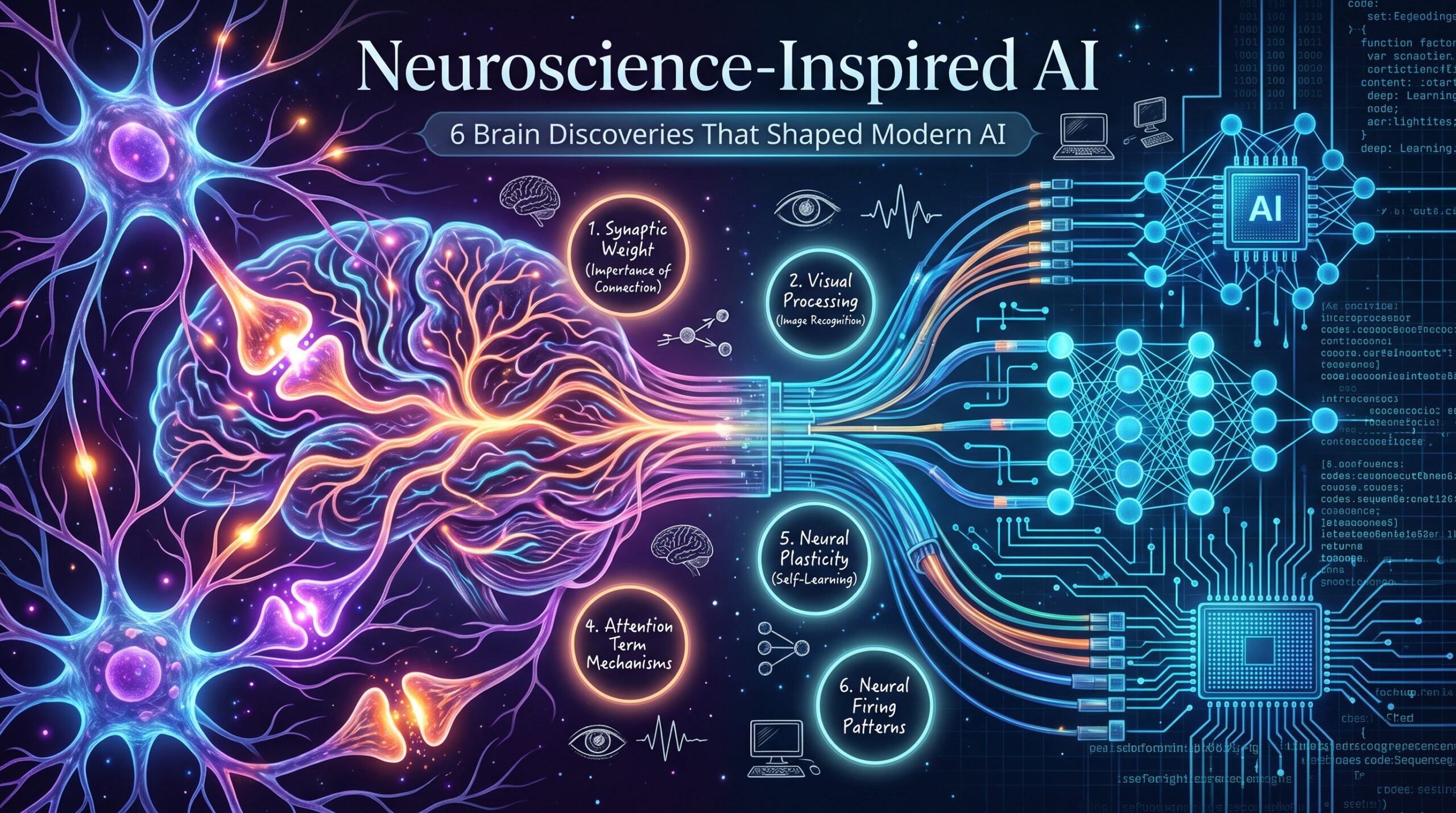
Some of the most powerful ideas in artificial intelligence did not come from computer science labs alone. They came from studying living brains. The story of neuroscience-inspired AI is a story of researchers watching how nerve cells behave, then asking whether machines could borrow the trick. In this article we profile six discoveries where brain science and AI intersected, and explain why they still matter.
Why Look to the Brain for Ideas?
The brain is the only proven example of general, flexible, energy-efficient intelligence. It makes sense that engineers would study it. But the relationship is subtle. AI researchers rarely copy biology exactly. Instead, they take a core principle, simplify it, and test whether it works in software. For a broader look at how the two compare, see our guide to [AI vs the human brain].
Breakthrough 1: The Artificial Neuron and the Perceptron
In 1943, Warren McCulloch and Walter Pitts proposed a simple mathematical model of a neuron that fires when its inputs pass a threshold. In 1958, Frank Rosenblatt built on this idea to introduce the perceptron, an early learning machine that could adjust its connection strengths from examples.
The perceptron was very limited, and its limits fueled a period of doubt about neural networks. But it planted the seed for everything that followed. Every modern network still uses units that add weighted inputs and decide whether to fire, exactly the concept you can explore in [neural networks explained simply].
Breakthrough 2: Hebbian Learning, “Fire Together, Wire Together”
In 1949, psychologist Donald Hebb proposed that when one neuron repeatedly helps activate another, the connection between them strengthens. It is often summarized as “cells that fire together wire together.”
This idea shaped how researchers thought about learning as a change in connection strength, which is the same basic concept behind adjusting weights in an artificial network. Modern deep learning mostly relies on backpropagation rather than pure Hebbian rules, and how closely backpropagation resembles anything the brain does remains debated. Still, Hebb’s insight that learning lives in the connections is central to the field.
Breakthrough 3: The Visual Cortex and Convolutional Neural Networks
In the late 1950s and 1960s, neuroscientists David Hubel and Torsten Wiesel studied the visual cortex of cats and discovered that individual neurons respond to specific features, like edges at particular orientations, and that simple detectors feed into more complex ones. They later received a Nobel Prize for this work.
This layered, feature-detecting structure inspired Kunihiko Fukushima’s Neocognitron in 1980, and later Yann LeCun’s convolutional neural networks (CNNs). CNNs scan images with small filters that detect edges and textures, then combine them into higher-level shapes. Today, CNN-style ideas underlie image recognition, medical imaging tools, and many other vision systems. It is one of the clearest success stories of neuroscience-inspired AI.
Breakthrough 4: Dopamine and Reinforcement Learning
Reinforcement learning is a way of training an agent by giving it rewards for good actions. It grew from psychology and computer science, and neuroscience later provided striking support for the idea.
Research by Wolfram Schultz and colleagues showed that dopamine neurons in the brain signal something like a reward prediction error: the difference between the reward expected and the reward received. That closely resembles the learning signal used in reinforcement learning algorithms, such as temporal difference learning. The match suggested that the brain and these algorithms may share a common principle, and it has encouraged researchers on both sides. Reinforcement learning has since powered game-playing systems and robotics research.
Breakthrough 5: Memory Replay and the Hippocampus
Neuroscientists observed that the hippocampus, a brain region involved in memory, appears to replay recent experiences, including during sleep. This replay is thought to help consolidate memories and learning.
AI researchers adopted a related idea called experience replay. Instead of learning only from the latest event, an agent stores past experiences and revisits them at random during training. This technique became an important part of deep reinforcement learning systems, including DeepMind’s Deep Q-Network, which learned to play Atari games. It also helps address the forgetting problem we discussed in our brain comparison.
Breakthrough 6: Attention and Neuromorphic Computing
Two more areas show the ongoing exchange of ideas.
Attention. Humans cannot process everything at once, so the brain selectively focuses on what is relevant. In AI, attention mechanisms let a model weigh which parts of its input matter most. Transformers, introduced in 2017 in the paper “Attention Is All You Need,” are built around this idea and power today’s large language models. The engineering version is a mathematical tool rather than a faithful copy of biological attention, but the inspiration and the metaphor are clearly connected.
Neuromorphic computing. Instead of running neural networks on conventional chips, neuromorphic engineers design hardware that mimics how neurons communicate using brief electrical spikes. Examples include research chips like IBM’s TrueNorth and Intel’s Loihi. Spiking neural networks and neuromorphic chips aim to reach the brain’s remarkable energy efficiency. They are still mostly research-stage, but they may matter for low-power devices.
A Quick Recognition: The 2024 Nobel Prize
In 2024, the Nobel Prize in Physics was awarded to John Hopfield and Geoffrey Hinton for foundational discoveries and inventions that enable machine learning with artificial neural networks. Hopfield’s associative memory model was itself inspired by ideas from neuroscience and physics. It is a good reminder of how much these fields overlap.
Where the Inspiration Stops
It is worth being careful here. Not every part of modern AI is brain-like, and not every brain-inspired idea has worked. Backpropagation, the workhorse of deep learning, has no clearly established biological counterpart, and the details of real neurons are far richer than artificial ones. Good neuroscience-inspired AI takes a useful principle, tests it, and keeps it only if it works.
Why This Matters for Beginners
If you are entering the field, understanding this history gives you a big advantage. It explains why the vocabulary looks the way it does, why certain architectures exist, and where future breakthroughs might come from. It also opens a career path: computational neuroscience and brain-inspired computing are growing areas. When you are ready to explore, our roadmap on [how to learn AI from scratch] can help you plan the journey.
Frequently Asked Questions
What is neuroscience-inspired AI? It refers to AI methods that borrow ideas from how brains work, such as layered visual processing, reward-based learning, or memory replay.
Are neural networks copies of the brain? No. They are simplified mathematical models loosely inspired by neurons. Real brains are far more complex.
Is brain-inspired AI the future? Possibly in part. Many researchers believe that ideas like energy-efficient spiking hardware and continual learning could benefit from brain science, but the direction of the field is still being worked out.
Key Takeaways
From the perceptron and Hebbian learning to visual cortex research, dopamine, memory replay, attention, and neuromorphic chips, the brain has repeatedly given AI researchers useful ideas. The two fields continue to learn from each other. Keeping an eye on both is one of the most exciting ways to stay curious about the future of intelligence, natural and artificial.
Want to try the ideas yourself? Build a CNN in one of our [beginner AI projects] and see the visual cortex idea working in code.