
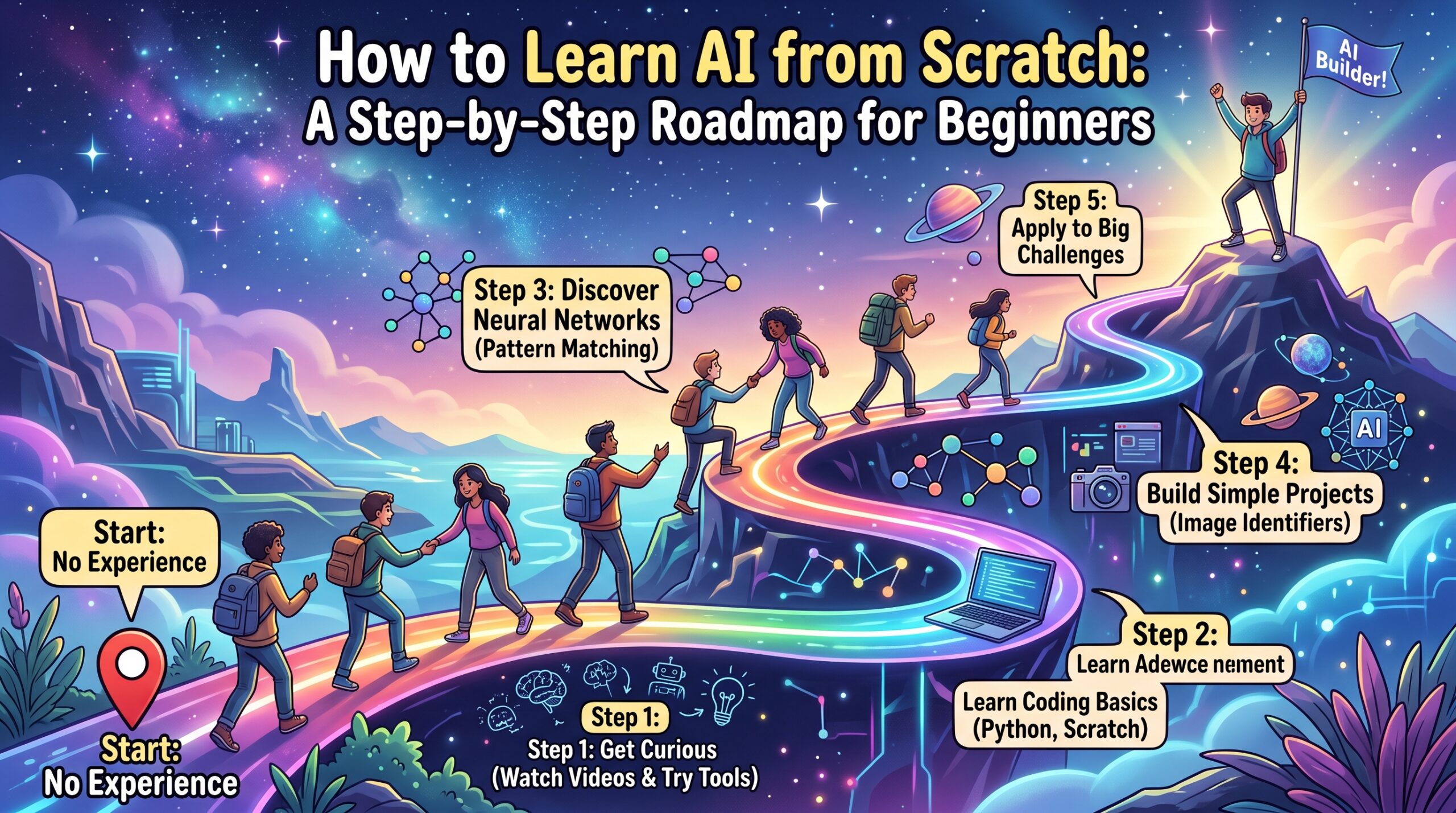
Artificial intelligence can look like a giant, locked door. There are new tools every week, endless courses, and people throwing around terms like transformers, embeddings, and reinforcement learning. The good news is that you do not have to learn everything at once. This roadmap explains how to learn AI from scratch in a clear order, so you always know what to do next.
First, Understand the Landscape
Three terms are often used interchangeably, but they are different layers:
- Artificial intelligence (AI): the broad field of building machines that perform tasks requiring intelligence.
- Machine learning (ML): a major approach within AI where systems learn from data instead of following fixed rules.
- Deep learning: a subset of machine learning that uses multi-layer neural networks.
Knowing this hierarchy keeps you from getting lost. If deep learning is new to you, our guide to [neural networks explained simply] is a friendly place to begin.
Step 1: Build Your Curiosity and Big-Picture Understanding (1 to 2 weeks)
Before writing code, spend a little time watching and reading for intuition. Good options include:
- The 3Blue1Brown video series on neural networks, which uses beautiful visuals to explain how they learn.
- Introductory articles and podcasts that explain what AI can and cannot do.
- Our comparison of [AI vs the human brain], which puts the technology into perspective.
The goal is not mastery. It is to build a mental map and feel motivated.
Step 2: Learn Python Basics (3 to 6 weeks)
Python is the working language of AI. Focus on the essentials:
- Variables, loops, and functions
- Lists and dictionaries
- Reading files and handling data
- Using libraries with pip
Free resources like the official Python tutorial, freeCodeCamp, and CS50’s Python course are excellent. Aim for comfort, not perfection. You will keep learning Python while you learn AI.
Step 3: Pick Up the Essential Math, Gradually (ongoing)
Math scares many beginners away, so let’s be honest about what matters:
- Statistics and probability: understanding averages, distributions, and uncertainty.
- Linear algebra: vectors and matrices, which is how data and network weights are represented.
- Calculus (basics): especially the idea of a derivative, which explains how models improve during training.
You do not need to master all of this before starting. Learn it alongside your projects, so each concept has a reason to exist. Khan Academy and 3Blue1Brown’s “Essence of” series are great, free starting points.
Step 4: Learn Core Machine Learning (6 to 10 weeks)
Now you are ready for the heart of the field. Learn the standard workflow: collect data, clean it, split it, train a model, evaluate it, and improve it. Key ideas to cover include:
- Supervised vs unsupervised learning
- Regression and classification
- Overfitting and underfitting
- Train, validation, and test sets
- Evaluation metrics like accuracy, precision, and recall
Popular starting courses include Andrew Ng’s Machine Learning Specialization and Kaggle’s free micro-courses. Practice with scikit-learn on small datasets.
Step 5: Build Beginner Projects (start early and keep going)
Do not wait until you “know enough.” Start projects as soon as you finish Step 2 and grow them as your skills grow. Projects make concepts stick and give you something to show. Our list of [beginner AI projects] gives you seven ideas that fit this stage perfectly, from an Iris classifier to a simple chatbot.
Step 6: Move Into Deep Learning (6 to 10 weeks)
With ML basics in place, dive into neural networks. Learn how layers, activation functions, loss, and backpropagation work, then build models with Keras or PyTorch. Then explore the main architectures:
- Convolutional neural networks for images
- Recurrent networks and transformers for text and sequences
The fast.ai course, DeepLearning.AI’s specializations, and the PyTorch tutorials are all well respected. This is also a good moment to read about the neuroscience roots of these ideas in our profiles of [neuroscience-inspired AI breakthroughs].
Step 7: Choose a Direction to Specialize
AI is huge, so eventually you will want a focus. Some common paths:
- Computer vision: teaching machines to interpret images and video
- Natural language processing: working with text and language models
- Reinforcement learning: agents that learn by trial and reward
- Data science and analytics: turning data into decisions
- AI ethics and policy: the societal side of the technology
- Computational neuroscience: where AI and brain science meet
Follow whatever excites you most. Interest is a powerful fuel.
Step 8: Join a Community and Show Your Work
Learning alone is slow. Join Kaggle competitions, Discord or Reddit study groups, and local meetups. Publish your projects on GitHub and write short explanations of what you built. Teaching others, even through a simple blog post, is one of the best ways to deepen your own understanding.
Common Mistakes to Avoid
- Tutorial hell: watching endless courses without building anything. Balance learning with doing.
- Skipping the fundamentals: jumping straight to advanced models can leave gaps that slow you later.
- Comparing yourself to experts: everyone you admire started as a confused beginner too.
- Chasing every new tool: foundations last, and trends come and go.
Frequently Asked Questions
Can I learn AI without a computer science degree? Yes. Many people enter AI through self-study, online courses, and projects. A degree can help, but it is not the only way in.
How long does it take to learn AI? Basic competence can take around six months of steady effort. Real depth takes years, and the field keeps evolving, so learning is ongoing.
Do I need a powerful computer? No. Google Colab and similar free services give you access to strong hardware in your browser.Key Takeaways
Learning AI is a marathon made of small, doable steps: build intuition, learn Python, pick up math as needed, study machine learning, build projects, then move into deep learning and a specialty. Stay curious, keep building, and share what you learn.
Ready to take the first step? Open a notebook, start a small project, and let your curiosity lead.