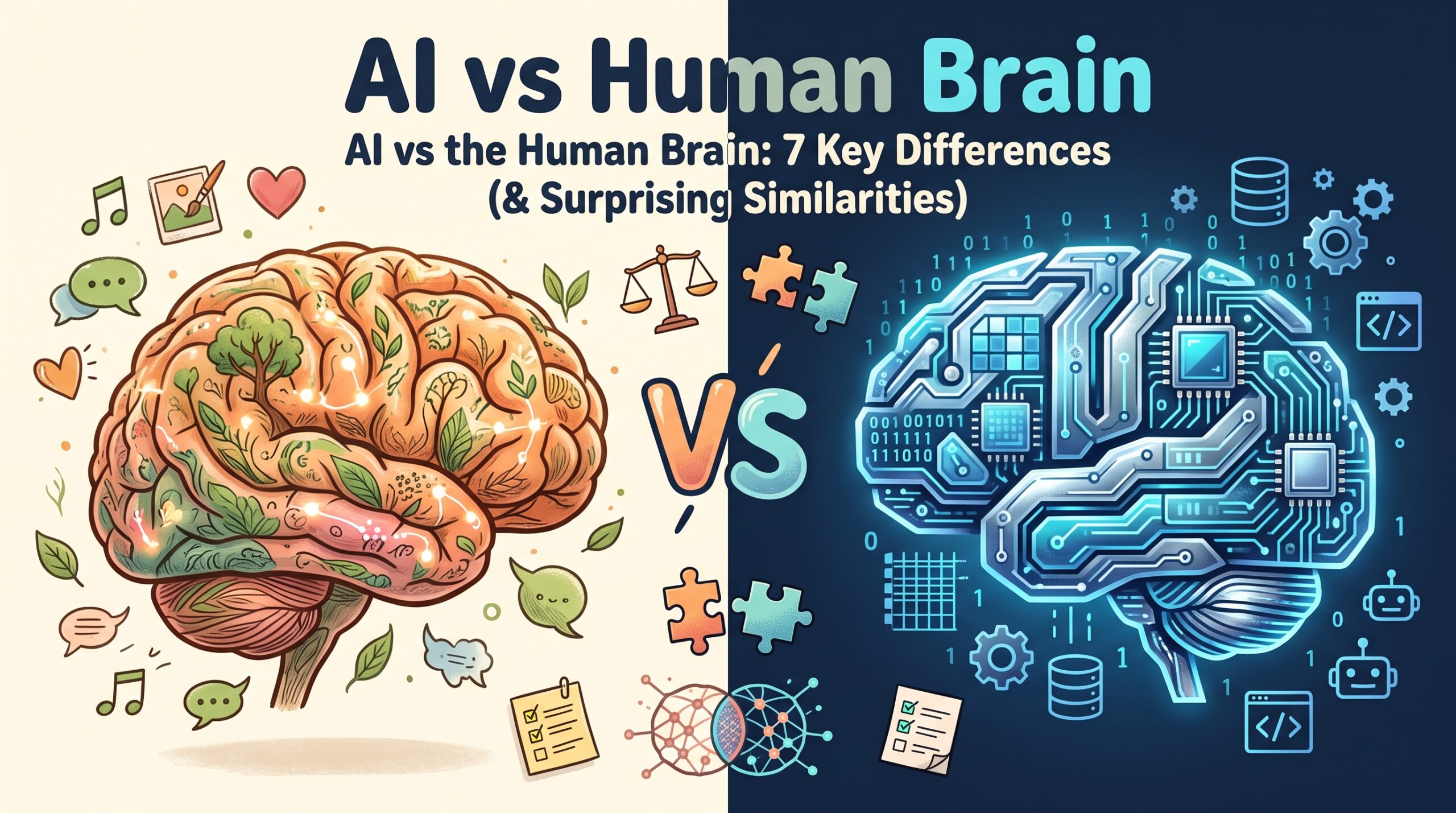
Headlines love to claim that AI is “thinking like a human” or that machines will soon match the brain. The truth is more interesting. When you compare AI vs the human brain, you find real inspiration, real overlap, and enormous differences. This guide breaks down seven of the most important ones so you can separate the hype from the science.
Why Compare AI and the Brain at All?
Modern AI began, in part, with a question: could we build machines that learn the way living things do? Early researchers in the 1940s and 1950s modeled simple mathematical neurons after what biology had revealed about nerve cells. That history is why we still use words like “neuron,” “network,” and “learning.”
But inspiration is not imitation. Understanding where the comparison holds up, and where it breaks, will make you a sharper learner and a more critical reader of AI news. If you are new to the mechanics, start with our guide to [neural networks explained simply].
Similarity 1: Both Learn From Experience
The most meaningful overlap is that both systems improve through experience. A child learns what a dog is by seeing many dogs, and an artificial neural network learns by seeing many labeled examples. In both cases, connections between units strengthen or weaken depending on what works.
In the brain, this happens at synapses, the junctions between neurons. In an artificial network, the equivalent is the weights. A famous summary from neuroscience, often phrased as “cells that fire together wire together,” captures the same spirit as adjusting weights during training.
Similarity 2: Both Use Networks of Simple Units
Neither a single neuron nor a single artificial neuron is very capable. Intelligence, or something like it, emerges from vast numbers of simple units connected together. The human brain contains roughly 86 billion neurons, and each can connect to thousands of others. Large AI models contain billions of parameters, which are the adjustable numbers that play a role similar to synaptic strengths.
Difference 1: Energy Efficiency
This is one of the starkest gaps. The human brain runs on roughly 20 watts, about the power of a dim light bulb. Training a large AI model can consume enormous amounts of electricity in data centers full of specialized chips. Even running these models day to day uses far more energy than the brain uses to do things like hold a conversation, recognize a friend, and plan dinner all at once.
Difference 2: How Much Data They Need
A toddler can often learn to recognize a new animal from one or two examples. Most AI systems need thousands or millions. Humans are remarkably good at generalizing from very little information, likely because we arrive with useful built-in structure and constantly draw on rich experience of the physical world. Researchers are actively working on “few-shot” learning to close this gap.
Difference 3: Understanding vs Pattern Matching
Today’s AI excels at detecting statistical patterns in data. That can look like understanding, but it is a different thing. A language model can write fluently about grief without ever having felt it. A person understands through a body, emotions, memories, and lived context. Whether machines could ever have anything like this is an open philosophical question, and it is worth being honest that experts disagree.
Difference 4: Biology Is Messier and Richer
An artificial neuron is a simple function: add up weighted inputs and apply an activation. A real neuron is a complex living cell. It uses electrical signals and dozens of chemical messengers, its dendrites can do their own computation, and it changes shape over time. Real brains also contain other important cells, such as glia, that we are still learning about. Artificial networks capture only a thin slice of this complexity.
Difference 5: Learning Never Really Stops in the Brain
The brain shows neuroplasticity, meaning it keeps rewiring throughout life in response to new experiences. Most AI models, by contrast, are trained once and then frozen. When you chat with a deployed model, it is not permanently updating its own weights from your conversation. Updating a network with new knowledge can also cause “catastrophic forgetting,” where learning something new overwrites something old. Brains handle this far more gracefully, and researchers study how sleep and memory replay help.
Difference 6: Speed and Precision vs Flexibility
Computers win at raw speed and accuracy on narrow tasks. They can multiply enormous numbers in a blink and never get tired. Neurons are much slower individually, yet the brain performs massive parallel processing and is exceptionally flexible. One brain can learn to cook, drive, play music, and comfort a friend. Most AI systems are specialists, built for one kind of task at a time.
Difference 7: Consciousness, Emotion, and Motivation
Brains come with drives, feelings, and a sense of self that shape everything they do. Current AI has no hunger, fear, curiosity, or goals of its own. It optimizes the objective we give it. Whether consciousness could ever arise in an artificial system is debated, and nobody has a settled answer.So Is AI Becoming Like the Brain?
In some narrow ways, yes. Ideas borrowed from neuroscience have improved AI, and the flow of ideas runs both directions, since AI models are now used to test theories about the brain. You can explore this in our profiles of [neuroscience-inspired AI breakthroughs]. But the two remain very different kinds of systems, and treating them as equivalent leads to confusion.
Frequently Asked Questions
Can AI think like a human? Not in the full sense. AI can match or exceed humans on specific tasks, but it does not have human-style understanding, emotions, or awareness.
Is the brain a computer? It is a useful metaphor in some ways, since the brain processes information. But the brain is analog, chemical, embodied, and massively parallel, which makes it unlike a conventional computer.
Will AI ever replicate the human brain? Nobody knows. It would require breakthroughs in both neuroscience and engineering, and we still do not fully understand how the brain works.
Key Takeaways
The comparison of AI vs the human brain is best understood as a conversation between two fields. Both learn from experience and rely on networks of simple units. They differ sharply in energy use, data efficiency, adaptability, and inner experience. Staying curious about both sides is exactly what makes this field so exciting for beginners.
Want to get hands-on with the AI side? Check out our [beginner AI projects] and see how these ideas translate into real code.